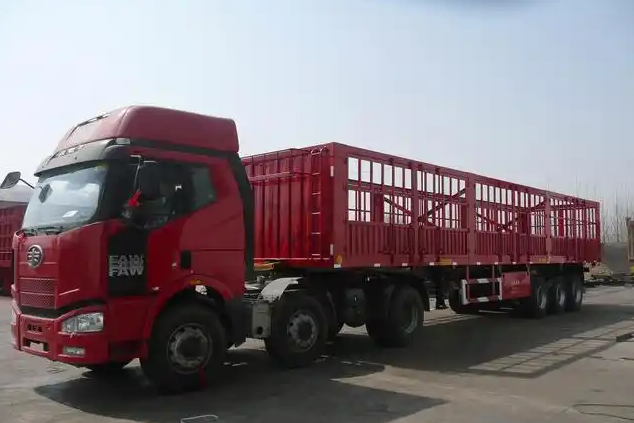
Choosing the right double semi trailer for Southeast Asia requires understanding regional import certification standards, axle weight regulations, and customization options tailored to each market—this guide covers selection, compliance, logistics, and practical tips for engineering equipment transport across Vietnam, Thailand, and Indonesia.
1. Understanding Your Market: Why Double Semi Trailers Dominate Southeast Asia Engineering Projects
【H2: Core Keyword (double semi trailer) + Module Header | Market Context Setup】
1.1 The Southeast Asia Heavy Equipment Transport Challenge
Double semi trailers remain the workhorse for engineering machinery transport in Vietnam, Thailand, and Indonesia. The region's boom in infrastructure, construction, and municipal projects drives demand for reliable heavy-haul solutions. These markets require trailers capable of carrying 50–60 tons of excavators, drilling equipment, and construction machinery across diverse terrain and road conditions. Understanding local regulations before committing to a purchase saves weeks of customs delays and expensive modifications.
1.2 Why Triple-Axle (3-Axle) Configuration Matters in Southeast Asia
Triple-axle semi trailers distribute weight evenly and comply with Southeast Asian axle load limits. Vietnam caps triple-axle trailers at approximately 26–28 tons per axle, Thailand permits up to 25 tons on 3-axle configurations, and Indonesia follows similar standards via its VPTI (Import Technical Verification) regulations. A properly specified double semi trailer with three axles, 60-ton payload capacity, 13-meter length, and 3000mm width meets baseline requirements—but market-specific customization is essential.
2. Technical Specifications & Customization for Regional Compliance: The Buying Decision Framework
【H2: Technical Specifications | Product Comparison & Customization Setup】
2.1 Core Double Semi Trailer Specifications for Southeast Asia
Standard specifications for heavy-duty equipment transport trailers in this region include:
Payload Capacity: 50–60 tons (supports excavators, drilling rigs, piling equipment)
Axle Configuration: 3 axles with 15–18-ton per-axle capacity (complies with Vietnam QCVN 11:2024, Thailand DLT weight limits)
Dimensions: Approximately 13,000mm length × 3,000mm width × 3,300mm height (suits Vietnam roads; requires permits in Thailand/Indonesia for maximum dimensions)
Suspension: Leaf-spring or air suspension for shock absorption on uneven construction sites
Platform: High-strength steel with 1,300mm saddle height—ideal for low-ground-clearance machinery
Tires: 12 wheels (6 per axle on trailer), typically 12R22.5 specification for heavy-duty application
Quick Reality Check: A 60-ton double semi trailer fully loaded approaches Southeast Asia's 26–28-ton per-axle legal limit. Distributors must verify actual load distribution to avoid fines at checkpoints—Vietnam imposes fines up to 25 million VND (~$1,000 USD) for axle-weight violations.
2.2 Anti-Corrosion & Material Customization: Stainless Steel vs. Carbon Steel Trade-Offs
Southeast Asia's humid tropical climate demands corrosion-resistant construction. For water-spraying and dust-control applications (common in construction sites), consider:
304 Stainless Steel Tank Option: Food-grade, excellent salt-spray resistance, suitable for potable water or light chemical spraying. Cost premium: ~15–20% over carbon steel.
Carbon Steel + Epoxy Coating: Lower upfront cost, adequate for dry-cargo transport and short-term industrial water use. Requires maintenance every 2–3 years in humid climates.
High-Strength Steel Frame (Q345B): Manganese-rich carbon steel offering durability and weight efficiency—standard across Chinese manufacturers.
Practical Tip: If your trailer operates within 50km of coastal zones (common in Vietnam's Ho Chi Minh City, Thailand's Bangkok, Indonesia's Jakarta/Surabaya), request 304 stainless steel tanks or double-layer anti-corrosion treatment. This adds 4–6 weeks to manufacturing but prevents tank replacement costs ($8,000–$15,000) within 3 years.
2.3 Modular Customization Options: Tank Capacity, Spray Systems & Narrow-Alley Adaptation
Double semi trailers can be customized for specialized applications:
Customization | Specification | Use Case | Cost Impact |
|---|---|---|---|
Water Tank Capacity | 8,000–12,000 liters (2,100–3,170 gallons) | Municipal water supply, dust suppression | +$1,200–$1,800 |
Spray Bar System | Multi-nozzle 3–6 meter spray width | Construction site watering, road dust control | +$800–$1,500 |
Narrowed Cargo Bed | Reduced to 2,800mm width | Tight urban alleyways (Vietnam cities) | +$600–$1,000 |
Reinforced Floor Boards | Increased thickness (8–10mm) | Heavy machinery loading | +$400–$800 |
Typical Lead Time: 4–6 weeks for customized double semi trailer manufacturing (excluding certification). Budget an additional 2–4 weeks for regional certification processing.
3. Regional Certification Roadmap: Navigating Vietnam COC, Thailand DLT & Indonesia VPTI Requirements
【H2: Certification Requirements | Compliance & Clearance Strategy | Regional Differentiation】
3.1 Vietnam: COC (Certificate of Conformity) via QCVN 11:2024 Standard
Vietnam requires imported trailers and semi-trailers to obtain a Certificate of Technical Safety, Quality & Environmental Protection (COC) under QCVN 11:2024/BGTVT regulations.
Process:
Submit technical documentation (design drawings, material specifications, braking system specs) to a Vietnamese notified body or inspection authority
Factory audit conducted by third-party test lab (ISO/IEC 17025 accredited)
Type approval issued (valid for 5 years; covers all units of same configuration)
Shipment certificate applied for each batch (requires inspection report at origin)
Timeline: 4–6 weeks for COC approval; add 1–2 weeks for shipment certificate per batch
Critical Checkpoint: Vietnam Customs requires the inspection report (tờ kiểm tra) attached to Bill of Lading. Missing this document delays clearance by 5–10 days at Saigon Port.
3.2 Thailand: DLT Type Approval & Department of Land Transport Certification
Thailand mandates Department of Land Transport (DLT) type approval for all motor vehicles and trailers entering the market. For double semi trailers:
Process:
Submit Type Approval application with emissions data, technical specifications, and brake performance test results
Vehicle inspection at licensed testing center
DLT issues type approval certificate (valid 10 years)
Individual units registered with Thailand's land transport authority
Timeline: 6–8 weeks for initial DLT type approval; subsequent units: 2–3 weeks per registration batch
Road Regulations to Note: Thailand's Highway Act limits tractor-trailer combinations to 50.5 tons GVW—your 60-ton double semi trailer exceeds this for certain chassis/tractor combinations. Confirm tractor weight + trailer weight ≤ 50.5 tons with local distributors before purchase.
3.3 Indonesia: VPTI (Verification Technical Import) & Conformity Declaration
Indonesia implements Import Technical Verification and Tracing (VPTI), mandatory for all imported vehicles and trailers exceeding specified product categories.
Process:
Pre-shipment inspection conducted by authorized VPTI body (SGS, Intertek, TÜV Rheinland) at origin port
Technical compliance verified against Indonesian national standards (SNI) and safety regulations
VPTI certificate issued; submitted to Indonesian Customs
Upon arrival, cargo cleared after Customs cross-check with VPTI certificate
Timeline: 3–4 weeks for VPTI inspection; certification valid for 90 days post-issuance
Cost: VPTI fees typically $600–$1,200 per shipment (covers inspection, documentation, Customs liaison)
Key Difference from Vietnam/Thailand: Indonesia does NOT require type approval for each unit—one VPTI certificate covers the entire shipment. This accelerates clearance but demands precise pre-shipment documentation.
4. Logistics & Clearance: Shipping Timeline, FOB vs. CIF Strategy & Customs Checkpoints
【H2: International Logistics | FOB/CIF Cost & Timeline Breakdown | Regional Shipping Routes】
4.1 Shipping Timeline & Port Routing: China to Southeast Asia
Typical Ocean Routes (Sea Freight):
Route | Transit Time | Typical Ports | Customs Clearance |
|---|---|---|---|
China → Vietnam | 2–5 days | Shanghai/Shenzhen → Ho Chi Minh City (HCMC) or Hai Phong | 3–5 days (with COC) |
China → Thailand | 4–6 days | Shanghai/Shenzhen → Laem Chabang (near Bangkok) | 5–7 days (with DLT pre-approval) |
China → Indonesia | 6–10 days | Shanghai/Shenzhen → Jakarta (Tanjung Priok) or Surabaya | 4–6 days (with VPTI) |
Total Logistics Window (FOB Origin to Destination Delivery):
FOB (Free on Board): Buyer arranges ocean freight, insurance, and destination clearance. Total cost: $8,000–$12,000 per trailer (ocean freight ~$2,500–$4,000; insurance $400–$600; local clearance $800–$1,200)
CIF (Cost, Insurance & Freight): Seller arranges all logistics to destination port. Buyer assumes risk at destination. Total cost: $14,000–$18,000 per trailer
Delivery Timeline: FOB origin → 25–30 days to final delivery (accounting for port delays, Customs processing, inland haulage)
4.2 Certification Document Checklist for Smooth Clearance
Before shipment, ensure all documents are complete:
✅ For Vietnam (COC Required):
Original COC certificate (or notarized copy)
Technical inspection report (tờ kiểm tra)
Product compliance declaration
Commercial invoice & packing list
Bill of Lading (must reference inspection report)
✅ For Thailand (DLT Pre-Approval):
DLT type approval number (obtain before shipment)
Technical specification sheet (approved by DLT)
Commercial invoice in Thai baht or English currency
Bill of Lading
✅ For Indonesia (VPTI Certificate):
VPTI inspection report (pre-shipment, valid 90 days)
Notarized commercial invoice
Packing list with detailed specifications
Bill of Lading with VPTI reference
Pro Tip: Missing a single document triggers 5–10 day delays. Assign a local customs broker early; budget $500–$800 per shipment for brokerage services.
4.3 Common Clearance Bottlenecks & Solutions
Problem | Why It Happens | Solution |
|---|---|---|
Vietnam: Inspection report not attached to BOL | Oversight during documentation | Coordinate with freight forwarder 48 hours before departure |
Thailand: DLT pre-approval missing | Importer assumes registration only needed at destination | Begin DLT type approval 8–10 weeks before import date |
Indonesia: VPTI inspection scheduled too late | VPTI body backlogs (peak season: Aug–Oct) | Book VPTI inspection 3 weeks in advance; arrange surveyor visit at factory |
Axle-weight declaration mismatch | Empty trailer weight miscalculated in specs | Verify unladen weight with manufacturer; cross-check against technical drawings |
5. Selection Framework: Matching Trailer Specs to Market Demand & Budget Constraints
【H2: Practical Selection Guide | Market-Specific Recommendations | Budget-to-Compliance Mapping】
5.1 Vietnam Market: Focus on COC Compliance & Modular Customization
Best For: Municipal water supply projects, dust-suppression on construction sites, small-scale waste management
Recommended Spec:
3-axle double semi trailer
50–55 ton payload (avoids extreme axle-load penalties)
8,000–10,000L water tank for spraying (common municipal requirement)
304 stainless steel tank (coastal humidity in HCMC/Hai Phong)
Budget: $22,000–$28,000 FOB (includes COC pre-approval)
Lead Time: 6–8 weeks manufacturing + 4–6 weeks COC certification = 10–14 weeks total
5.2 Thailand Market: DLT Type Approval & Wider Chassis Options
Best For: Highway transport, intermodal container delivery, industrial equipment hauling
Recommended Spec:
3-axle configuration with reinforced suspension
45–50 ton payload (aligned with Thailand's 50.5-ton GVW highway limit)
Narrower tank or cargo bed (2,900mm max width for standard lanes)
Carbon steel frame + epoxy coating (lower humidity risk in northern Thailand)
Budget: $24,000–$30,000 CIF Bangkok (includes DLT pre-approval brokerage)
Lead Time: 6–8 weeks manufacturing + 6–8 weeks DLT type approval = 12–16 weeks total
5.3 Indonesia Market: VPTI Efficiency & Bulk Import Advantage
Best For: Infrastructure projects, port operations, energy sector (generator transport)
Recommended Spec:
3-axle standard configuration
50–60 ton payload (VPTI non-issue if documentation accurate)
Multi-compartment or specialized tank (common for fuel/water contracts)
High-strength steel frame
Budget: $20,000–$26,000 FOB Shanghai (VPTI costs separate: +$600–$1,200 per shipment)
Lead Time: 4–6 weeks manufacturing + 3–4 weeks VPTI = 7–10 weeks total (fastest regional option)
6. Troubleshooting & Real-World Pitfalls: Lessons from Southeast Asia Imports
【H2: Practical Risk Mitigation | Common Failure Modes & Prevention Strategy】
6.1 Axle Weight Miscalculation & Road Penalties
The Problem: Trailers imported with inaccurate unladen weight declarations get stopped at highway checkpoints. Vietnam fines: 25 million VND (~$1,000); Thailand: 5,000–40,000 baht (~$140–$1,140).
Why It Happens: Manufacturers estimate unladen weight; actual weight varies by frame thickness, tank material, and suspension type.
Solution:
Request factory weigh-ticket before shipment
Cross-check against technical drawings (gross axle weight rating should match load distribution)
Provide accurate unladen weight to Customs broker for pre-declaration
For Vietnam, attach weight certificate to COC documentation
6.2 Tank Corrosion in Humid Climates
The Problem: Carbon steel tanks rust within 18–24 months in coastal Southeast Asia, reducing payload capacity and requiring expensive replacement ($10,000–$15,000).
Why It Happens: Tropical humidity (80–95% in coastal zones) accelerates oxidation on unprotected steel.
Solution:
Specify 304 stainless steel tank for Vietnam/Thailand coastal operations
If budget-constrained, request manufacturer apply two-layer epoxy + polyurethane coating
Schedule annual anti-corrosion inspections in hot/humid season
Apply zinc-rich primer annually in high-risk environments
6.3 Certification Document Loss in Transit
The Problem: Original COC, DLT, or VPTI certificates go missing during ocean freight, stalling clearance.
Why It Happens: Documents packed in general cargo; physical certificates damaged by moisture or mishandling.
Solution:
Request notarized copies of all certificates (accepted by Customs in Vietnam/Thailand/Indonesia)
Email scanned copies to freight forwarder and customs broker 2 weeks before arrival
Carry original certificates in separate sealed envelope labeled "Cargo Documents"
Use international courier (DHL/FedEx) for critical document backup delivery
6.4 Spray System Incompatibility with Local Water Quality
The Problem: High-pressure spray nozzles clog on mineral-rich or sediment-heavy water in Southeast Asian construction sites, reducing operational hours.
Why It Happens: Trailer manufacturer specs assume clean municipal water; site water contains calcium deposits, sand, clay.
Solution:
Specify multi-mesh filtration system (50–100 micron pre-filter) as OEM option
Request stainless-steel nozzles (resist mineral buildup vs. brass)
Include water-softening cartridge in annual maintenance kit
Train operator on weekly filter cleaning—extends spray-system life by 30–40%
7. Next Steps: Actionable Import Timeline & Supplier Vetting
【H2: Action Planning | Supplier Evaluation & Import Checklist】
7.1 Decision Timeline: 16-Week Import Roadmap
Week | Action | Responsibility |
|---|---|---|
Week 1–2 | Finalize market choice (Vietnam/Thailand/Indonesia); gather regional compliance docs | Buyer + Customs broker |
Week 3–4 | Request quotes from 2–3 Chinese manufacturers (include certification costs) | Buyer |
Week 5–8 | Manufacturing phase; coordinate factory weigh-ticket & document review | Manufacturer + QC |
Week 9–12 | Certification processing (COC/DLT/VPTI); arrange pre-shipment inspection | Certification body |
Week 13–14 | Ocean freight booking; document handover to freight forwarder | Freight forwarder |
Week 15–16 | Customs clearance at destination; final delivery & registration | Customs broker |
7.2 Supplier Vetting Checklist
✅ Manufacturer Credentials:
ISO 9001 quality management certification
Minimum 10 years semi-trailer manufacturing experience
Factory QCVN/CE/DLT documentation audit trail (ask for previous export references)
✅ Certification Support:
Does supplier include COC/DLT pre-approval costs in quote, or separate?
Can they provide notarized copies for Vietnam/Thailand/Indonesia separately?
Do they coordinate with regional certification bodies, or buyer arranges?
✅ Customization Capability:
Can they integrate stainless-steel tanks, spray systems, narrow-chassis options on-schedule?
What's the change-order lead time if specs evolve mid-production?
✅ Post-Sale Support:
Do they provide 1-year warranty covering frame/axle defects?
Is spare parts availability documented for Vietnam/Thailand/Indonesia dealers?
Quick Reference Table: Regional Comparison at a Glance
Criteria | Vietnam | Thailand | Indonesia |
|---|---|---|---|
Primary Certification | COC (QCVN 11:2024) | DLT Type Approval | VPTI |
Lead Time | 10–14 weeks | 12–16 weeks | 7–10 weeks |
Typical Cost | $22–28K FOB | $24–30K CIF | $20–26K FOB |
Ocean Transit | 2–5 days | 4–6 days | 6–10 days |
Axle Weight Limit (3-axle) | ~26–28 tons | ~25 tons | ~26 tons |
Key Risk | COC document loss; coastal corrosion | DLT pre-approval delays | VPTI inspection backlog (Aug–Oct) |
Best Trailer Type | Water/dust spraying; modular | Highway/intermodal; durable | Bulk industrial; cost-efficient |
Conclusion: Making the Right Choice for Your Southeast Asia Expansion
Selecting a double semi trailer for Vietnam, Thailand, or Indonesia requires balancing technical specifications, regional certification standards, and logistics efficiency. The 60-ton triple-axle configuration with stainless-steel corrosion protection remains the market standard, but customization—tank capacity, spray systems, narrowed chassis—drives project success.
Start now: Choose your primary market, engage a regional customs broker, request manufacturer quotes with full certification cost breakdowns, and schedule a factory inspection 4–6 weeks before your target import date. Budget 10–16 weeks for full import cycle, allocate $500–$1,200 for local brokerage, and maintain backup documentation (notarized copies) for every certificate.
Your double semi trailer investment in Southeast Asia pays dividends with proper planning—avoid the costly pitfalls by committing to early compliance and thorough supplier vetting today.